Patient question
What is a partial knee replacement?
 Dr. Pablo GelberOrthopaedic Knee Surgeon
Quick answer
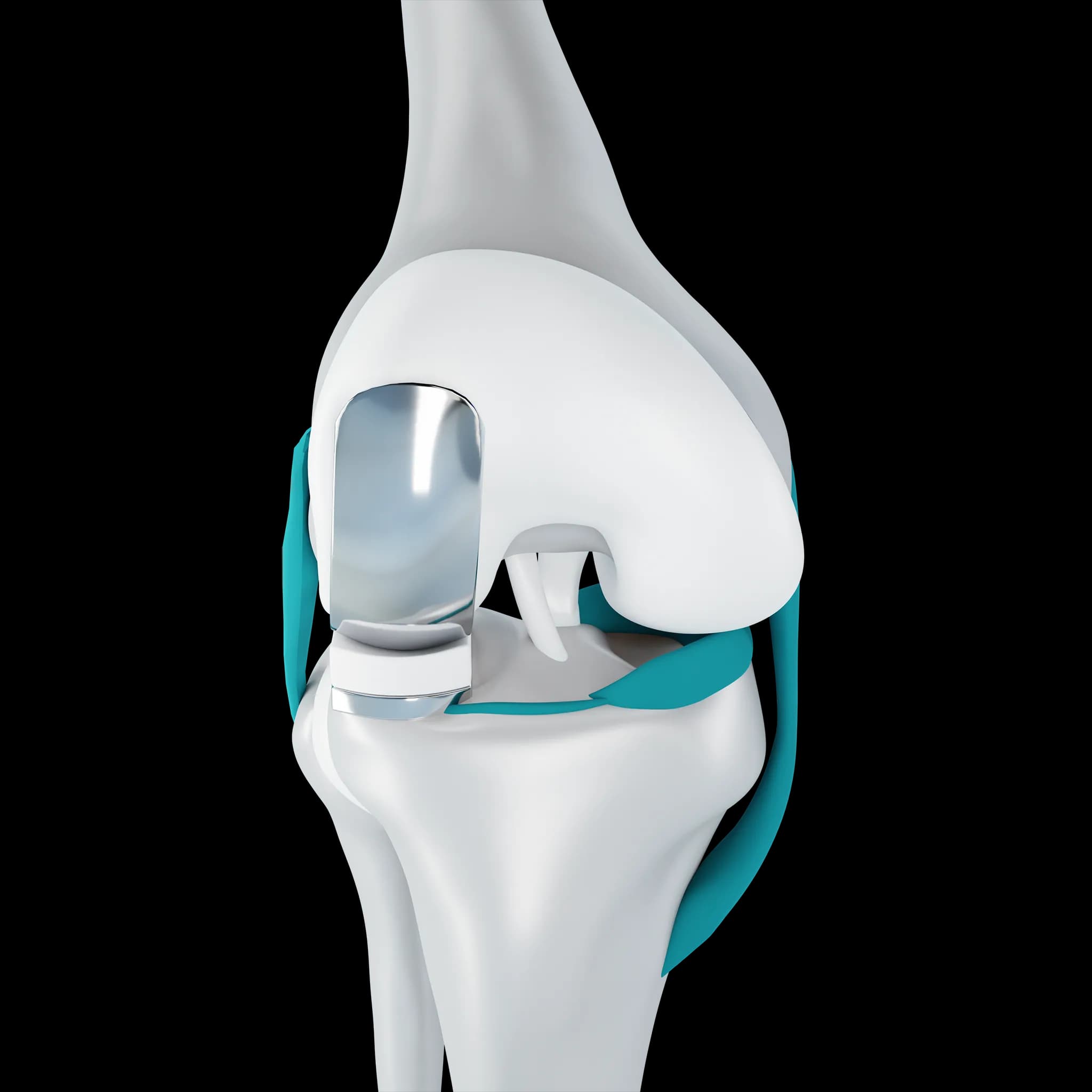
A partial knee replacement resurfaces only the one compartment of the knee that is worn out, usually the inner side, and keeps the healthy cartilage, the other compartments and the cruciate ligaments. It suits arthritis confined to one area, explains Dr. Pablo Gelber, knee surgeon at Aman Hospital in Doha.
The knee has three compartments
The knee can be thought of as three areas where bones meet: the inner (medial) compartment, the outer (lateral) compartment, and the joint behind the kneecap (patellofemoral). Osteoarthritis does not always wear all three evenly. In many people, especially those who are slightly bow-legged, the inner side wears first while the rest of the knee stays in reasonable condition.
A partial knee replacement, also called a unicompartmental or "uni" knee replacement, replaces only the damaged compartment. A total knee replacement resurfaces all of the joint surfaces.
What the operation involves
Through a smaller incision than a total knee, the worn cartilage and a thin layer of bone are removed from the end of the thigh bone and the top of the shin bone on the affected side. They are replaced with metal components and a plastic bearing that glides between them.
- Inner (medial) partial replacement is the most common type
- Outer (lateral) partial replacement is less common and more technically demanding
- Patellofemoral replacement resurfaces only the groove behind the kneecap
Because the ligaments and the healthy parts of the knee are kept, many patients say the knee feels more like their own.
Who it is usually suited to
A partial replacement is generally considered when arthritis is limited to one compartment, the knee bends well, the deformity is mild and correctable, and the ligaments, particularly the ACL, are working. Pain should be felt mainly on the worn side rather than all around the knee.
It is not suitable when arthritis is widespread, in inflammatory arthritis such as rheumatoid arthritis, or when the knee is very stiff or unstable. Those knees are usually better served by a total replacement.
How the decision is made in Doha
At Aman Hospital, Dr. Gelber examines the knee, checks ligament stability and range of motion, and reviews standing X-rays, sometimes with stress views or an MRI to confirm that the other compartments are healthy. Surgery is only discussed once simpler measures such as weight management, strengthening and activity changes are no longer enough.
Frequently asked questions
Is a partial knee replacement a smaller operation?
Yes, in the sense that less bone is removed and the incision is shorter. Most patients recover faster than after a total knee, but it is still a joint replacement and needs proper rehabilitation.
Can a partial replacement be converted to a total one later?
Yes. If arthritis develops in another compartment or the implant wears, it can usually be revised to a total knee replacement.
Is it the same as keyhole surgery?
No. Arthroscopy (keyhole surgery) does not replace anything. A partial replacement uses a small open incision to place implants.
Related
